Modern & Samtida konst
+ Design & Klockor
Till katalogen »
To be sold at our Important Sale: Modern & Contemporary Art + Design 13 – 15 May 2025
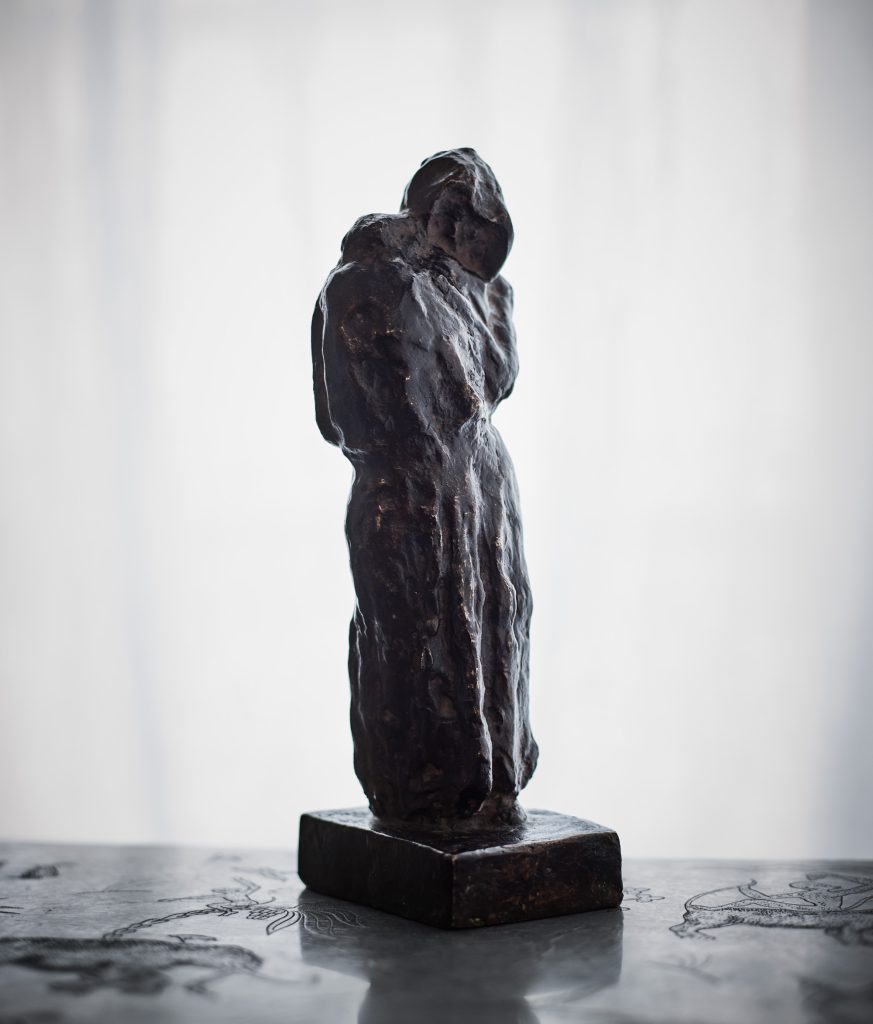
Lot 603 Julio González (Spain 1876‑1942). ”Petite maternité au capuchon”. Signed and numbered © By R. Gonzalez 1/9. Patinated bronze, Height 21.8 cm.
Conceived in 1906.
The authenticity of this lot has kindly been confirmed by Philippe Grimminger,
Julio González Administration. A certificate will be issued for the forthcoming owner.
The model of this sculpture in terracotta, is in the collections of Julio González Administration archives.
Another cast of this sculpture, marked H.C. (Hors Commerce), is in the collection of Centre Georges Pompidou, Paris, inv. no. ZZ, AM 1379 S (donated by Roberta González in 1964).
300.000 – 400.000 SEK
€ 27.000 – 36.000
A Swedish private collection.
Jörn Merkert, Tomas Llorens and Margit Rowell, Julio González: catalogue raisonné des sculptures, 1987, compare with the sculpture in terracotta cat. no. 18, p. 28.
Julio González began his career as an artisan metalworker in the family workshop in Barcelona, alongside his elder brother, Joan. He was from a lineage of metalsmith workers and artists. His grandfather was a goldsmith worker and his father, Concordio González, a metalsmith worker who taught him the techniques of metalsmith in his childhood years. His mother, Pilar Pellicer Fenés, came from a long line of artists. Julio and his brother had higher artistic ambitions. In the late 1890s they frequented the café and cabaret Els Quatre Gats, a meeting point of many artists, especially those related to the Catalan ‘Modernisme’, also known as Catalan art nouveau. They also took painting and drawing classes in the evenings. Julio González met Pablo Picasso, and they became great friends.
After their father’s death, the brothers decided to sell the family business and pursue their shared dream by moving to Paris. In the early 1900, the González brothers settled in Montparnasse, at the time the avant gardist hub in Paris. They reconnected with the artists Pablo Picasso, Manolo Hugué, Pablo Gargallo, and Joaquin Torres-Garcia, friends from Barcelona, as well as writers and critics, like Max Jacob. Julio González exhibited for the first time at the Salon des Indépendants in 1907. The older brother Joan sadly passed away in 1908 due to fragile health. Julio was devastated but carried on. The following year he married a French woman, and their daughter Roberta was born. The marriage did not last, Roberta was raised by her father and aunts in a Catalan enclave in Montparnasse.
In the late 1910s, Julio learned the oxyacetylene welding and cutting technique in the Renault factory in Boulogne-sur-Seine. This technique subsequently became his principal contribution to sculpture, both his own iron sculptures as well as collaborations with Pablo Picasso and Constantin Brâncuși. Influenced by Picasso, González deeply changed his style in the 1930s. He exchanged bronze for iron, and volumes for lines. González began to formalize a new visual language in sculpture that changed the course of his career. By breaking the boundaries between artistic and industrial practices Gonzales became very successful and is still remembered as one of the most innovative sculptors of the 20th century.
Roberta González, Julio’s only child, pursued the family’s artistic vocation. Her father encouraged her creative pursuits. She began her career in the late 1920s. In 1939 she married the German abstract painter, Hans Hartung. Alongside her own artistic career Roberta González worked tirelessly to promote her father’s work, in hopes of attaining the recognition that his revolutionary work deserved. She organized major retrospectives in numerous countries and several continents and made donations of his work to prestigious institutions. Today, González’s works are present in the world’s most renowned museums, institutions and collections.
“Petite maternité au capuchon” was conceived in 1906 and cast by Busato in Paris under the supervision of Roberta González. This sculpture in our sale presents an exciting opportunity to acquire one of Julio González earliest examples of artistic expression. An intimate scene between a mother and her child captured in the moment. ■